
Travel Update 5: The W Trek

Kris and I arrived in Puerto Natales after a one-night stopover in Punta Arenas to be met by drizzly grey skies and chilly weather. Our mood coming in to the town was a little despondent, as we had given up on being able to do the full five-day W trek or its cousin, the nine-day O trek, back in December when it looked like there was zero campsite availability through the online booking system (there were a few dates open at random times, but those were only for deluxe tent setups that ran $280 USD per night for two people... not including food!). We were determined to make the best of it and figure out a few day hikes in the famous Torres del Paine national park, and we figured we could come back another year with a feel for the lay of the land to do the full trek.
And then... Kris met up with an old friend who had just done the trek, and he shared that there were people on the circuit with their own tent and food, with no bookings at any of the refugios. From everything we had read, that was something that wasn’t supposed to be possible! Didn’t they check paperwork at the entrance to the park to make sure you had a set itinerary with campsites booked? Apparently not.
We were a little nervous about the idea, but we figured it was better to try and fail than to not try at all. If we had a tent and our own food, we could find somewhere to wild camp if there was no space at a refugio to pitch our tent. So, that’s what we did. We rented a tent and all the camping gear we needed from our hostel (a charming place called Casa de Barro, which was a decent walk from the city centre but made up for it with character and a good amount of green space outside), bought all the camp food we would need for the five days we planned to be out, reorganized our hostel reservation, and packed our bags for the trek. The next morning we got up before dawn and walked to the bus station for the early bus to the park entrance, still nervous and each in our own private “what-if’s” about getting turned back from the trek.
But... nothing happened. No one looked at us twice as we got into the park, no one checked that we had a campsite booked, nothing. We just showed our park pass, transferred to a park shuttle for the Torres del Paine trailhead, and started walking with everyone else. We started to think that this just might work.
Since we didn’t really have a plan, we thought we might be able to find an open tent spot at Refugio Chilenos, which is the campsite partway to the iconic Torres del Paine that the park gets its name from. That idea got us a laugh and a firm “no” from the campsite operators, who explained that this was the smallest refugio with the least flat ground, so there were no “simple” tent sites available, but there was one deluxe set up for, yes, $280 USD for the night. No thanks, we agreed, we’ll carry our tent back to the trailhead and find a place at the much more spacious Camping Central. In our decision making process, we somehow looked directly at the large pile of trekking packs resting in a corner and failed to draw any inferences about the steepness of the trail vs. the utility of carrying camping gear beyond the refugio, so we drew some odd looks from other hikers by being the only two people on the trail with packs bigger than a small day bag. At least we had the good sense to drop our loads at the ranger station near the end of the trail, just before it got really steep.
The last kilometre of trail up to the Torres del Pain was steep, technical, and crowded, which made it slow going but about equal in difficulty to the Squamish Chief. At the lake, we met and made friends with Lindsay and James, a couple of Americans going the same direction as us on the W trek, and we stayed for an hour until the ranger came around to make sure everyone headed out before they closed the trail for the day. (Lindsay and James, if you’re reading this, hi from San Pedro de Atacama!) The hike to the Torres del Paine was a little underwhelming, overall, and Don’t Waste Your Time in the Canadian Rockies might only give it 3 out of 4 bootprints... the view at the end is iconic and beautiful, but it’s a long, forested, uphill journey to get there and there aren’t a lot of view points on the way.


We got back to Central late in the evening, a little wet from the rain, and were glad to find a covered area to cook food and dry out a bit. The drizzle didn’t end that evening, so once we were fed we made quick work of picking a site and setting up our tent, then crawling in and getting to bed. Since this was the only campsite on the W trek that is directly accessible by road (Chileno is supplied by horses, and the other sites can be accessed by trail or boat), it was run by Chilean teenagers who were more interested in scrolling on their phones and flirting with each other than checking tickets... we could have probably gotten away with pitching our tent anywhere and not paying the campsite fees, but since it was our first night and we didn’t want to risk it, we paid for our site in cash and got a significant discount... but no receipt.
The next morning was still rainy and windy, so we waited in the tent for as long as we could to see if it would clear. When the sun didn’t show any signs of coming out and drying our tent off, we made our breakfast and packed up for the day. We had to push ourselves with our trekking poles along the flat trail into the fierce wind, skipping around puddles that hadn’t been there the day before, and crossing streams that had been clear and burbling the day before and were now swollen and turbid with the rain. We hiked 11 kilometres the second day, with wind and rain coming and clearing in fits the whole day. We crossed three major streams that, the day before, we would have hopped across and hardly noticed, but now were knee deep with no bridges this far into the park. I kept as dry as I could by simply taking my shoes off and stripping down to my boxers for the crossings; hikers going the opposite direction, on the last day of their trek, just plowed through the water with their boots and pants still on. It was a long day (our late morning wasn’t working in our favour) although the clouds lifted enough from time to time for us to see the mountains of the park to our right and the lakes and low hills outside the park to our left.


We arrived at Refugio Los Cuernos (“The Horns”) about an hour before dark and snagged the second-to-last open tent platform. Mercifully, the refugio had a warming space with a wood stove and hot water on tap, so we were able to warm up and dry off while we ate. The rain finally gave up for the day after we arrived at the refugio, so even though our tent fly was soaking wet it started to dry immediately once we set it up.
Our third day was dry, with a few clouds, and we set off knowing we would have a long hike in front of us. We passed Refugio Frances after just a few kilometres, then the old and now-defunct Camping Italiano. The park has suffered from numerous large forest fires over the last few decades that have taken a toll on the lenga beech forests, and all the operating campsites are next to a lake for safety reasons. There is a meeting of three trails at Italiano — east, where we had come from, is the Torres del Paine and one end of the “W” shape of the trekking route; to the north, the trail climbs into the centre of the park with viewpoints of glaciers and sheer stone towers; to the southwest is the Paine Grande campsite and the west side of the “W”.

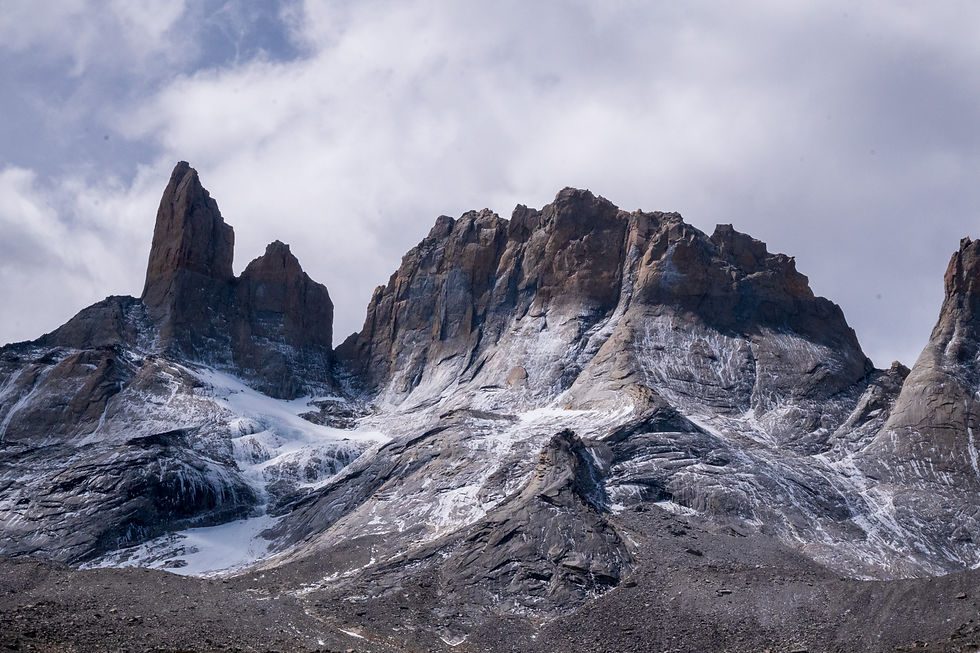
The trail north from Italiano was nothing short of spectacular — this section of trail definitely deserves four out of four bootprints. The trail was technical but not super steep, and the views to every side were jaw dropping and constantly changing. The glaciers of Valle Frances loomed over the first viewpoint, just 2.5 km from Italiano, and at the end of the out-and-back trail, 6.5 km from Italiano, the Mirador Britanico was surrounded by a ring of peaks, towers, glaciers, and forests. There was so much there that it was really impossible to capture the feeling of it in a photograph (which I think is why the Torres del Paine are the symbol of the park, since they make for a more romantic and iconic image), but this was easily the most impressive day of the trek for both of us.




Time was getting on when we finally returned to Italiano to claim our gear — we’d learned from our first day and wisely decided not to bring tents and sleeping bags where they wouldn’t be needed — so we found a sheltered space on the side of the trail to make ourselves dinner before making the final push to the Paine Grande campsite and refugio. James, from the first day, passed us as we were eating, and we caught up with him a little ways down the trail and finished the last few kilometres of the hike with him. The wind was mostly in our favour as we approached the refugio, and even though we often turned to look back at the towers behind us in the evening light we were pretty happy to spot a modest brown building and a cluster of bright yellow tents in the distance. At Paine Grande we found a relaxed, welcoming campsite and a mini-market selling snacks, food, and small essentials, so we bought a bit of extra food to make sure our packs wouldn’t feel too light over the next two days. All told, we covered 26 km on our third day, so we were more than happy to crawl into our sleeping bags and say goodnight to our sore feet.

On our fourth day, we set out for the Grey Glacier and the furthest point on the “W”. Our plan was to camp at Refugio Grey and return to Paine Grande on our fifth day to catch a boat across the lake and a bus back to Puerto Natales. This was a short day in terms of distance, but the wind was strong and we were hiking directly upwind for most of the day, so it made for tiring walking. We were glad for the small patches of shelter that we found as we went. We made it to the refugio after a few hours of hiking, pitched our tent, and walked out to Mirador Grey half a kilometre away. In 1947, the glacier reached all the way to the mirador and visitors might have been surrounded on three sides by the ice, but now the toe of the glacier is two and a half kilometres further up the lake.
On the morning of our fifth day, we hiked further along the trail to a better view of the glacier, then turned back for Paine Grande and the end of our trek. The wind was at our backs, mercifully, we were almost sailing back along the path that had taken so much effort the day before. The weather, as always, was unpredictable: for most of the day we had sun and wind, but just before lunch a downpour chased us into a sheltered forest. After we had eaten and reached the edge of the forest, the rain was still coming nearly horizontally and it looked like the last part of the hike could turn into a bit of an epic... so we sat down where we were, pulled out our stove, and made tea, on the very British-feeling supposition that “tea makes everything better.” And you know what? We weren’t wrong. By the time the water was hot, the stove away, and the tea steeped, the rain had blown over a little and it was closer to a drizzle than a downpour.


We were grinning at each other as we reached Paine Grande and the dock for the catamaran that would take us across Lago Pehoé and connect us to our bus back to Puerto Natales. We managed to catch a ride on an earlier boat than we had booked. The whole time we were staring at the glacier, hiking back to the Paine Grande, getting on the boat, and watching the lake roll past behind us, we kept looking over at each other and exclaiming “we did it!” like the whole trip was finally real now that all the uncertainty was behind us, now that we had accomplished something that we weren’t supposed to be able to do.
I took way more photos than I could fit into this update... some of the overflow is online here. Thanks for taking the time to read! I hope this is is a relaxing break from the usual social media drip update ❤️ I'm posting this from Sucre, Bolivia, and there's still about a month gap between this update and today so a lot of stuff has happened that I still haven't written about.