
Travel Update 6: Migrating North

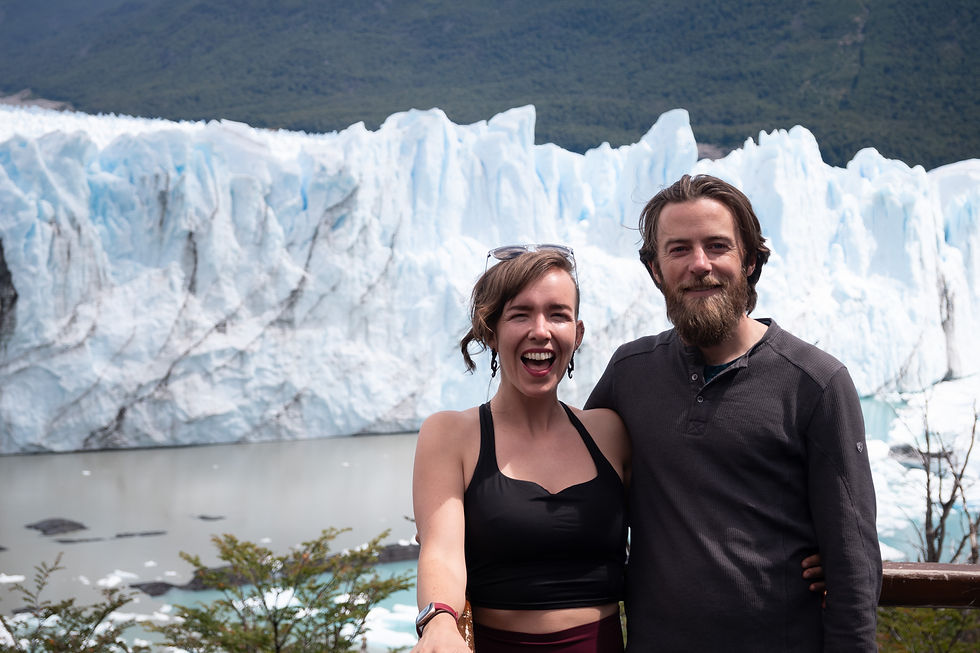
After the W Trek, Kris and I started heading north, staying in the eastern foothills of the mountains of Patagonia. Our first stop was El Calafate, a few hours by bus from Puerto Natales. The main attraction there is the proximity to the Perito Moreno glacier, which flows off the Southern Patagonia Ice Field into Lago Argentino. Since the water is fairly deep, the glacier calves off into icebergs on a regular basis, and we got to watch as a huge underwater chunk of ice broke off and surfaced with a rush of water pouring off its top and sides. The glacier used to occasionally extend as far as the shore where the viewing platforms sit, splitting Lago Argentino in two. This would dam one side and flood the upper half of the lake until the water eroded the glacier and burst through in massive outbursts that could reach flows of 8,000 cubic metres per second. Glaciologists call this cycle "dam–ice bridge–rupture"; the last time it happened was in 2019, but as the glacier has been retreating since 2020 the consensus is that it may never happen again (not in this civilizational epoch, anyways...) It was a relaxing few hours just taking in the size of the glacier, watching chunks fall and splash into the lake, and seeing icebergs drift and occasionally roll over in the water.

From there we caught a bus to El Chaltén, famous for the Mount Fitzroy skyline (aka, the Patagonia clothing brand logo) and more spectacular Patagonian mountains. We did a few big day hikes to find different views around the area, and by the time we finished we both agreed we’d done enough hiking for a little while. There was Laguna de los Tres with views of Mount Fitzroy, Laguna Torre with icebergs and lenga forests, and the Chorrillo del Salto waterfall just outside of town that rivals Shannon Falls in Squamish for volume of water and the beauty of the natural amphitheatre it tumbles into. The area is a mecca for climbers and alpinists, and there are campsites full of climbers close to the mountains to shave time and distance off their mornings (and a massive bird called a crested caracara tearing apart someone’s food bag).


One part that I particularly loved about this area was the lenga trees. They don’t grow particularly high, but they’re incredibly resilient. Trees will have whole limbs, and even sometimes their main trunks, dead and rotting, but some part of the tree has kept flowing nutrients to and from the viable branches and green leaves. Every tree is shaped differently, in twisted and branched tangles, but they don’t give up until the wind knocks them over and they’re severed from their roots.

At the end of our stay in El Chaltén, Argentina was starting to wear our budgets thin; the country has seen triple-digit inflation for the past two years, and grocery prices were higher than we see in Canada. We were also looking ahead to a long stretch of country that — apart from a five-day ferry that we might have had to wait weeks to board — didn’t have many spots on the map that called to us. We decided to cut our time in Argentina short, and so on January 26 we jumped on a flight north from El Calafate to Santiago, Chile.
The shift from Patagonia to Santiago had a few challenges, notably heat and language. For our first few days in Santiago we were trying to be active in the middle of the day, then getting smacked by the heat and finding ourselves exhausted by dinner time. We clued in that the concept of siesta exists for a reason and started to adjust our schedule to rest or do laptop work in the middle of the day. It turns out that Chilean Spanish is as difficult to understand as everyone says it is, too: people in the central region of Chile speak quickly, tend to drop the “s” sound from many words, and run words together in a way that makes it difficult for (these) novice Spanish speakers to understand.
In Santiago, we found a walking tour with a guide who showed us around the city and managed to explain some of the complicated history of Chile’s military dictatorship, the CIA’s role in disrupting the country’s economy and fostering said dictatorship, the attempt to write a new constitution in recent years, and some of the history and symbolism of murals and street art in Santiago and other Chilean cities. I won’t attempt to relay the details here, because I’m not sure I completely understand them even after multiple walking tours in Santiago and Valparaiso, but suffice it to say the United States’ long history of meddling destabilizing other countries for its own ideological reasons is still very present in people’s memories and lived realities in South America.
The tour ended near a fantastic restaurant called CHPE Libre, specializing in Chilean and Peruvian ceviche and pisco sours. We sampled both, and decided that Peruvian ceviche — with large chunks of fish, spicy lime leche del tigre, red onions, and two kinds of corn — won over Chilean, but that the Chilean pisco edged out the Peruvian with a more complex, smoky flavour.

We visited a funicular (a cross between a short railroad, an elevator, and a ski lift) that took us up Cerro San Cristóbal for views of the city, the museum of fine arts and its bewilderingly terrible temporary exhibits, and the mayhem of architectural strata that is Cerro Santa Lucia. The history of Santa Lucia is worth speculating about:
It started as a rock.
Someone built a castle on it.
Someone else built pleasure gardens and terraces; they probably went bankrupt.
There was an earthquake and things got a little crooked, but not so much that anyone fixed them.
Someone built stairs and handrails and binoculars on poles.
A Japanese garden seemed like a good idea for a while.
People gave up and put cactuses everywhere.
A solid but bewildering 5 on the Stonehenge → Stonehenge II scale of historical experiences.
We also visited Santiago’s Bahá’í temple, on the eastern outskirts of the city where the urban sprawl climbs partway up the low desert mountains before giving up and giving way to wilderness. Because of its elevation and distinctive architecture, the temple is visible from almost any place in the city where you can get above the three- and four-story buildings that make up most of the urban core. Santiago has a remarkably good public transit system, so we were able to take advantage of that to get to the entrance to the temple grounds, where a taxi driver was shuttling visitors up the last (but not insignificant) hill for the equivalent of a dollar per person. Since it was the heat of the day, we gladly accepted the ride. The Bahá’í faith is a modern, loosely Abrahamic religion with centres and temples all over the world; it promotes peace, prayer, and connection to nature, while eschewing priests or clergy of any kind — their centres run on volunteer effort, and there are no temple services — and supporting the idea that all world religions are valid paths for connection to the divine. The temple fits in beautifully with the natural landscape of the mountains, and the gardens surrounding it use local, drought-resistant plants that are well adapted to Santiago’s dry climate; apparently the other temples around the world are similarly adapted to their local environments.
The volunteers at the visitor centre explained that the temple is full of symbolism: it is circular and has nine doors to represent the plurality of paths to god. Nine was chosen because it is the largest single-digit number (when the very kind and earnest volunteer explained this I had to bite my tongue to suppress some pedantic arguments about roman numerals as well as some choice Spinal Tap references... I don’t have much patience for numerology). The garden paths curve in spirals around the temple to give the gardens a sense of dancing around and towards the centre. Ironically, we found that six of the nine doors were, in fact, locked, while two were open to encourage a breeze but roped off, and only one was open for people to use; similarly, all but one of the garden paths was roped off for minor maintenance. If we’re reading into the symbolism, someone had clearly let their desire for order and proper behaviour get in the way of encouraging people to have diverse experiences of the space. Being conscientious and deeply spiritual people, Kris and I decided the only right course of action was to climb over the ropes and explore the garden paths anyways; after all, how distressing would it be for someone to find out that their actions had inhibited someone from connecting deeply to the divinity of the natural world? Whoever you are, rope-setter, I forgive you.

Once we’d had enough of Santiago, we caught a bus to Valparaiso, the closes port city to Santiago. Most of the Chileans we talked to warned us that the city was a little on the sketchy side; it had once been an important stopover port for Europeans travelling around the southern tip of South America to reach the California gold fields, but fell into decline once the Panama Canal was completed and a shorter route became possible. These days, the city is home to a lot of anti-government, communist, and anarchist political views, but also a thriving artistic community. The hostel we stayed at was full of art and posters for theatre shows, and the streets are full of murals, graffiti, and (once the sun sets) live music. One night out, we walked past an experimental noise band playing from a porch, then a punk band rocking out in a small plaza, then found a club with a seven-piece all-female band featuring an accordion, oboe, electric guitar, and two drummers playing fusion music from all over the world. It was some of the best live music I’ve heard in a long, long time.
We stayed in Valparaiso for a few days, did a few walking tours, ate some transcendent seafood, visited the sister city of Vina del Mar for a day, gawked at the street art, browsed a Japanese anime convention in the old city prison and came away with a knitted penguin with a strawberry helmet (a phrase I never in my life thought I’d write), and then we were ready to go.


We planned a long travel day to San Pedro de Atacama, since we couldn’t find anything that really drew us between Valparaiso and San Pedro; the north of Chile seems to have a lot of mining and fishing but less tourism than the central and southern parts. It ended up being a very long day: there was the bus from Valparaiso to Santiago, then a 23-hour bus from Santiago north to Calama, then another bus from Calama inland to San Pedro de Atacama. But, all the connections went smoothly, and in the early afternoon of February 7, we were in a place I’d wanted to visit ever since I first heard about it twelve years ago.